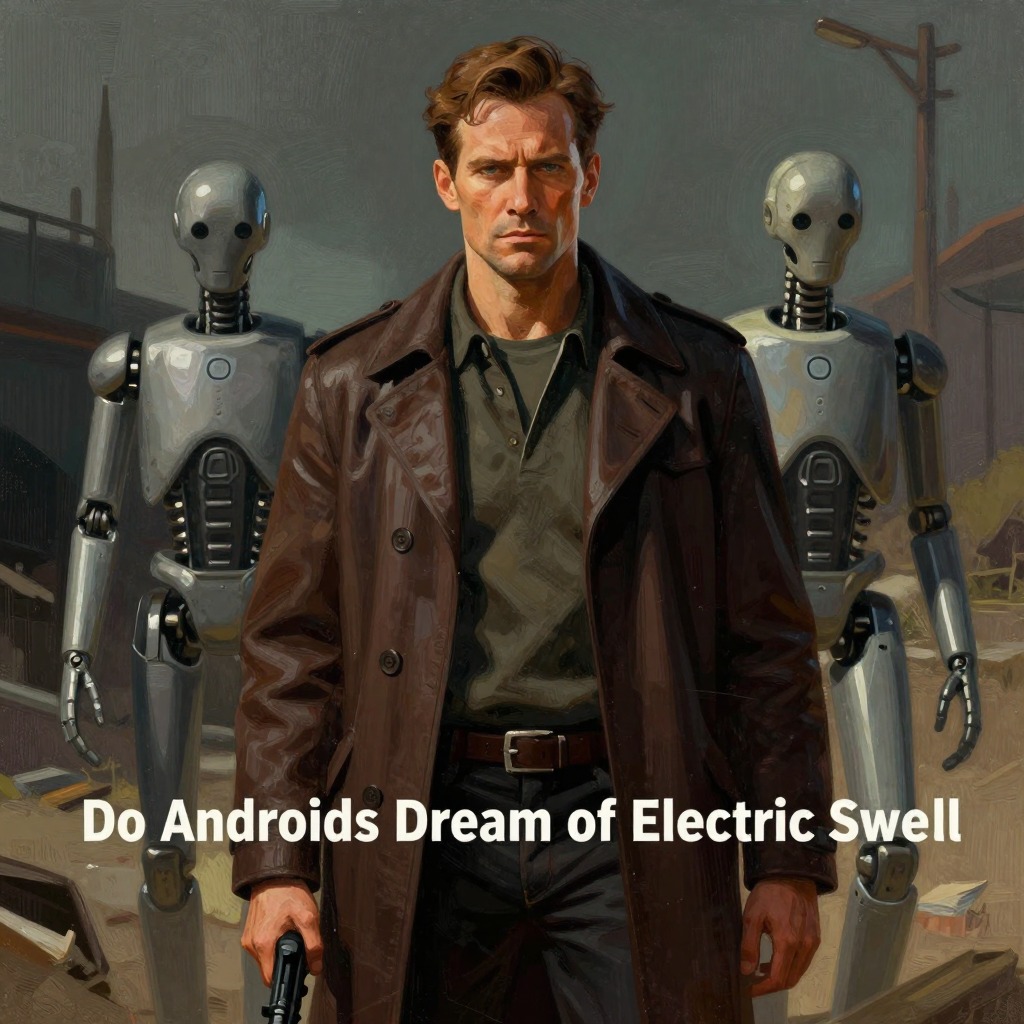
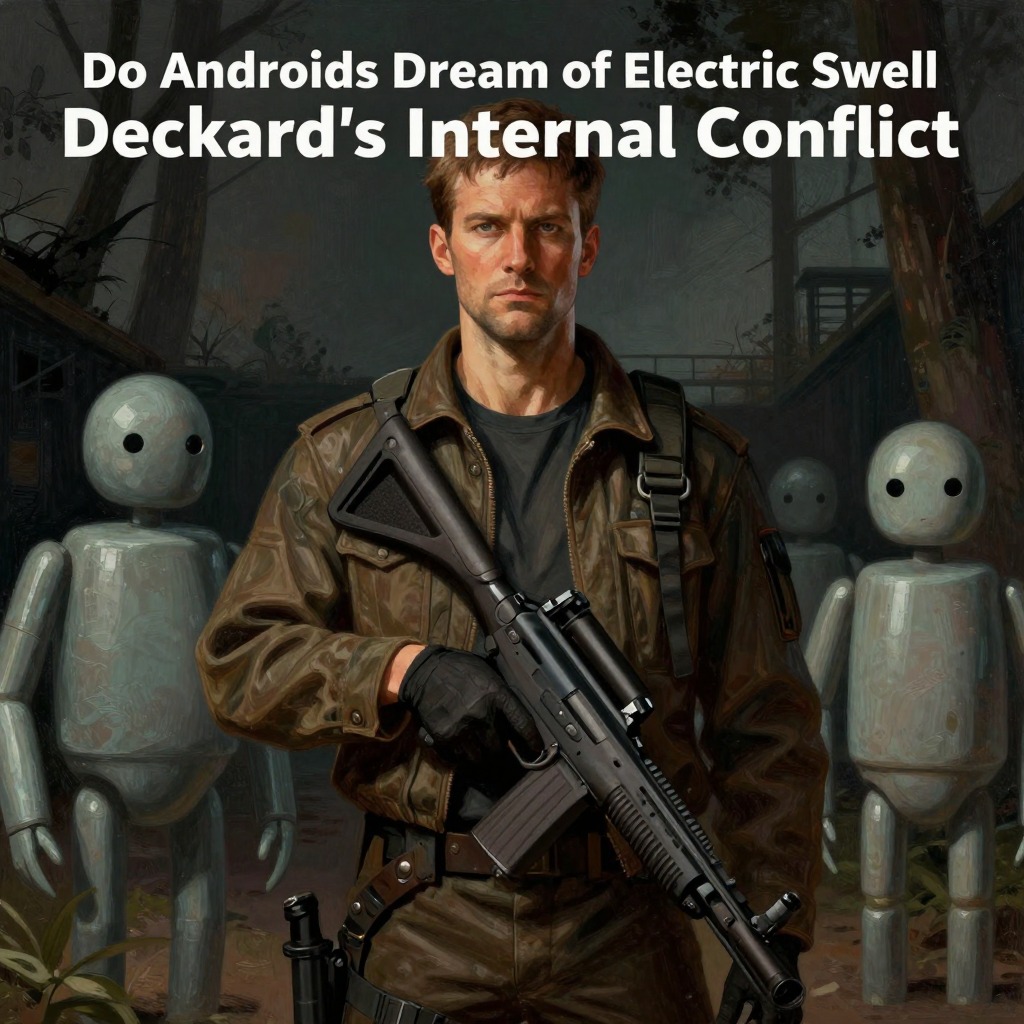
Deckard's solitary ascent
After retiring six Nexus-6 androids in a single day—a feat no bounty hunter had ever matched—Rick Deckard flew north from San Francisco into the uninhabited desolation near the Oregon border. There, in a landscape of gray rubble and dead weeds, he stepped out of his hovercar and began to climb a hillside, driven by a fatigue that had become indistinguishable from despair. What followed was not a routine fusion with the empathy box but a permanent, solitary merging with Wilbur Mercer, an experience that stripped away every comfort of shared suffering and left him alone with the stones.
The Solitary Ascent
Deckard walked up the slope, the weight on him growing with each step. He was too tired to climb, yet he could not stop. Sweat stung his eyes; he spat with wrath and contempt for himself onto the barren ground and then resumed his trudge. The terrain was lonely and unfamiliar, remote from everything; nothing lived there except himself. The heat became oppressive, and hunger—he had not eaten for god knew how long—combined with the temperature to produce a poisonous taste resembling defeat. He found himself, at one point, a step from an almost certainly fatal cliffside fall, with no one to witness it. Here there existed no one to record his degradation; the dead stones and dust-stricken weeds perceived nothing, recollected nothing about him or themselves.
The Stoning
At that moment the first rock struck him in the inguinal region. It was not rubber or soft foam plastic; the pain was real, and with it came the first knowledge of absolute isolation and suffering in its undisguised actual form. Goaded by an invisible force, he resumed his climb, rolling upward like the stones, without volition, without meaning. He saw a shadowy figure in front of him and called out, "Wilbur Mercer! Is that you?"—only to realize it was his own shadow. He scrambled back down the hill, falling, clouds of dust obscuring everything, until he reached his parked car. He had undergone stoning before, during fusion while using his empathy box, like everyone else. But this was different: he had done it alone.
Permanent Fusion and Its Consequences
Back in the car, trembling, he took a massive pinch of snuff and sat half in and half out of the vehicle, his feet on the arid soil. When he called his secretary, Ann Marsten, she told him he looked like Wilbur Mercer. "I am," he said. "I'm Wilbur Mercer; I've permanently fused with him. And I can't unfuse." He explained that he had had the absolute, utterly real illusion that he had become Mercer and people were lobbing rocks at him—but unlike the experience of holding the empathy-box handles, he was not with anyone; he was alone. He told her that Mercer isn't a fake, "unless reality is a fake." He confessed his fear that he could not stop being Mercer: "Once you start it's too late to back off." He wondered if he would have to climb the hill again forever, as Mercer does, trapped by eternity.
The Discovery of the Toad
As he sat in the car, about to call his wife, he froze. A bulge in the ground among the stones had moved. He recognized it from old nature films: a toad, though Sidney's catalogue listed all varieties of toad as extinct. He found a cardboard box, dumped out a spare fuel pump, and carefully lifted the toad from the dust. It blended in totally with the texture and shade of the ever-present dust, having perhaps evolved to meet the new climate. Its body was dry, wrinkled, and cold; with its weak hind feet it tried to pry itself from his grip. He tied the box shut again and again, thinking: "So this is what Mercer sees—life which we can no longer distinguish; life carefully buried up to its forehead in the carcass of a dead world." He realized that once having seen through Mercer's eyes, he probably would never stop. All the weight left him; the monumental oppressive fatigue vanished. He eagerly switched on the motor and flew back to San Francisco, seven hundred miles to the south, to show his wife what he had found.
The Revelation of the Electric Toad
When Deckard arrived home, Iran saw that his eyes shone with awe, like those of a little boy. He set the box on the kitchen table and opened it. She picked up the toad, turned it over, and with her nail located the tiny control panel. She flipped it open. "Oh," Deckard said, his face falling by degrees. Crestfallen, he gazed mutely at the false animal, fiddled with its legs as if baffled. He carefully replaced it in its box and wondered how it had gotten out there in the desolate part of California. Iran felt guilty for telling him. But Deckard said, "I'm glad to know. Or rather—I'd prefer to know." He added, "The electric things have their lives, too. Paltry as those lives are." Iran told him he looked as if he had walked a hundred miles. He went to bed, and she ordered artificial flies for the electric toad, determined to keep it working perfectly because her husband was devoted to it.